 Log in


Former German intelligence chief August Hanning is accused of treason and spying for a foreign agency after allegedly obtaining about 2,000 classified BND documents and using them in dealings with intelligence officials from an unnamed foreign country.
Berlin has not publicly named the recipient, but emails obtained by The Cradle reveal a relationship between Hanning and former Mossad director Danny Yatom.
August Hanning headed the BND from 1998 to 2005. He was arrested on 6 October on suspicion of espionage-related offenses.
Prosecutors allege that Hanning obtained sensitive documents from Manfred D., a former BND employee. The documents reportedly included internal briefings prepared for senior German officials.
The case has revealed how vulnerable Germany’s intelligence apparatus is to people who exploit their official positions and personal networks for private gain.
Emails between Hanning and Yatom provide a glimpse into those networks
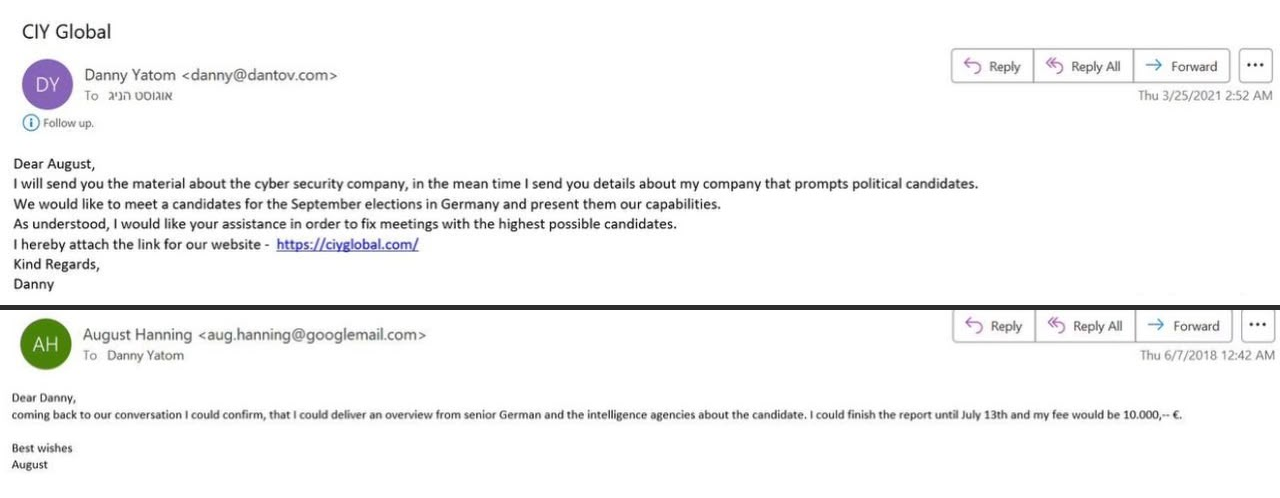
In 2018, Hanning told Yatom he could provide “an overview from senior German and the intelligence agencies about the candidate.” He offered to complete the report by 13 July for €10,000.
The email does not name the candidate, but the exchange sheds light on the nature of the relationship.
Three years later, Yatom approached Hanning about arranging meetings with senior candidates in Germany’s September 2021 federal election.
The former Mossad chief wanted to show the candidates what his “political-campaign company”, CIY Global, could do. In the same email, he mentioned material he planned to send about a cybersecurity firm.
Although the emails concern separate matters, together they reveal the relationship: Hanning offered access to German intelligence and political circles, while Yatom built businesses around political influence and cybersecurity.
These were not two former officials who had simply gone their separate ways after leaving public service. Their correspondence reveals an ongoing relationship where intelligence contacts and commercial ambitions intersected.
Their business ties extended beyond political campaigning. Yatom was linked to World Health Energy Holdings, a cybersecurity company where Hanning reportedly served on the advisory side.
The shadow network connected a former BND chief and a Mossad director through businesses where access to sensitive information and political decision-makers can be highly lucrative.
Israel has built a global market for surveillance, cyber-intelligence and political influence, partly staffed by intelligence veterans. These firms give capabilities developed in intelligence commercial cover and international reach.
Across Europe, impacts are evident. On 12 October, Polish prosecutors said data collected by the Pegasus spyware had been sent abroad and that Israel's NSO Group retained technical access to parts of the system.
Under Poland’s previous government, Pegasus targeted political opponents and others, exposing the risks of letting an Israeli company access infrastructure used to collect highly sensitive political and personal data.
In Spain, the 2022 CatalanGate investigation documented at least 65 people connected to Catalan politics and civil society who were targeted or infected with Pegasus or Candiru spyware.
Those affected included politicians, lawyers, and civil society figures. Researchers at the University of Toronto’s Citizen Lab found strong circumstantial evidence linking the campaign to Spanish authorities.
Greece’s surveillance scandal involved targeting journalist Thanasis Koukakis and European Parliament member Nikos Androulakis, along with the use of Predator spyware linked to Intellexa, a company founded by former Israeli intelligence operative Tal Dilian.
Across these cases, surveillance tools from Israeli-linked firms targeted people whose work and politics challenged those in power.
Israel has established itself as one of the world’s leading exporters of technologies for penetrating phones, monitoring political opponents and obtaining information that would otherwise remain private, while former intelligence personnel have turned their experience into profitable international businesses.
The Hanning affair raises the possibility that this same world of intelligence veterans, private ventures, and political access also played a role in handling Germany’s state secrets.
The 2018 email shows Hanning offering intelligence-related reporting to Yatom for a fee.
The 2021 email shows Yatom seeking Hanning’s help reaching senior German political candidates.
Their cybersecurity business ties add another layer to the relationship. These facts do not establish where the documents at the centre of the espionage case ultimately went, but they give German investigators a concrete reason to examine whether interests linked to Israeli intelligence were involved.

